We’ve lived with the landscaping that came with our house for years, and the truth is, we never really loved it. It never felt like us, with a confused mix of tropical palms, hibiscus, birds of paradise, and also rose bushes. This year, we were finally ready to change that and create the Mediterranean Southern California backyard I’ve always envisioned.
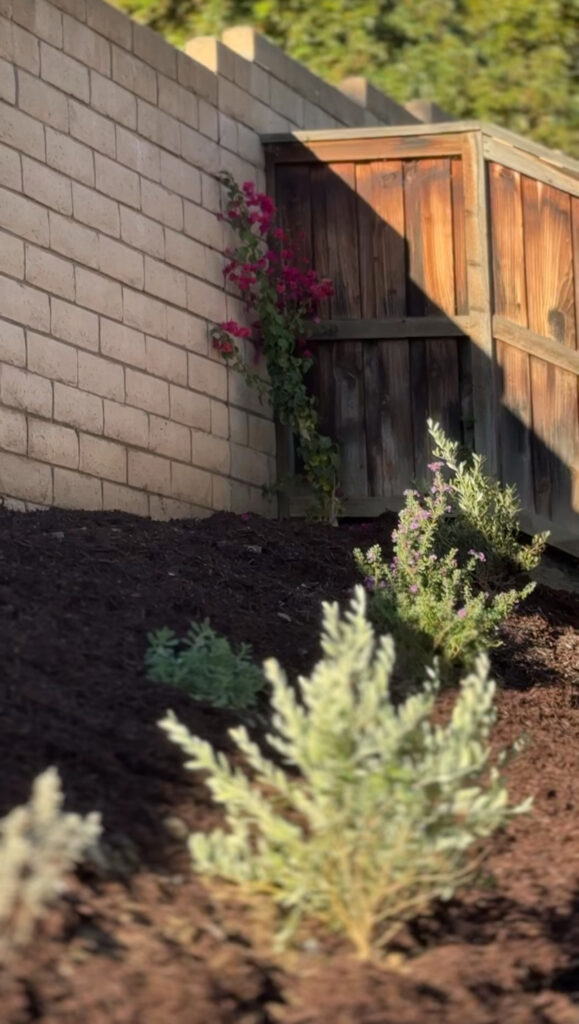
We live in inland Southern California, where summers are hot, sunshine is abundant, and choosing plants that can handle the climate matters. Our area falls around USDA Hardiness Zones 9b–10a, so we have relatively mild winters and a long growing season—but our summer temperatures can also climb above 100°F.
Our backyard has a large sunny slope behind the pool and one side of the yard, mature palms, and beautiful hill, mountain and city views, so there was already a lot to work with. We didn’t want to tear absolutely everything out and start over. Instead, the goal was to keep the elements we liked and completely rethink the rest.
I’ve always loved Mediterranean-inspired landscaping—muted and silvery greens, lavender and purple blooms, pops of bright pink, natural textures, and plants that made sense for our hot Southern California climate.
But early on, this project also became about making the backyard more useful. Along with the new landscaping, we added fruit trees, I’m getting ready to start my first-ever vegetable garden, and next summer I’m hoping to turn a corner of our slope into a DIY pumpkin patch!
We’re still watching everything grow in, but our Mediterranean Southern California backyard already feels so much more like us and is already bringing me joy!
Here’s everything we’ve done so far, including the plants and fruit trees we chose, how we approached landscaping a sunny Southern California slope, the mulch we used, and what we’re planning next.
Affiliate links may be used in this blog post, at no cost to you.
Finally Making the Backyard Feel Like Us
Before choosing any new plants, we cleared out quite a bit of the landscaping that came with the house while keeping the mature palms and cherry tree we wanted to incorporate into the new design.
One of the biggest changes happened along our fence line, where we removed two massive birds of paradise. The largest was nearly as big as the house, and removing them opened up much more of the hill, mountain and city view beyond our backyard.
On the slope, we kept the mature palms, our existing burgundy cherry tree, and a patch of ice plant that I planted three summers ago.
With a much cleaner starting point, we could finally begin creating a landscape that felt intentional and much more like our style.
Designing a Mediterranean Landscape for Southern California
I say Mediterranean-inspired because we aren’t trying to create a perfectly traditional Mediterranean garden.
Instead, we took the elements I love about Mediterranean landscaping and adapted them to an inland Southern California backyard.
The palette is mostly soft greens, silvery and gray-green foliage, purple flowers, and pops of magenta and hot pink. Our existing burgundy cherry tree adds another deeper color to the mix.
I wanted the landscaping to feel relaxed rather than overly manicured. There needed to be enough repetition for everything to feel cohesive, but I didn’t want rows of identical plants or every inch of the slope filled.
Climate was another big consideration.
USDA Hardiness Zones 9b–10a tell us quite a bit about our relatively mild winter temperatures, but hardiness zones only tell part of the story when you’re landscaping in Southern California. Our inland location also means dealing with intense sunshine and summer temperatures that can climb above 100°F.
So rather than choosing plants based on appearance alone, we looked for plants that gave us the Mediterranean-inspired colors and textures we wanted while also making sense for a hot, sunny Southern California landscape.
And there’s still one Mediterranean-inspired element I would absolutely love to add someday: a limestone trough fountain.
That’s the dream for this backyard eventually, but in the meantime, I’ve already created a much more affordable version. You can see how I made our DIY Mediterranean-style water fountain here. It’s an easy way to bring some of that old-world Mediterranean feeling into a backyard without investing in an antique or custom limestone trough.
Plants in Our Mediterranean Southern California Backyard
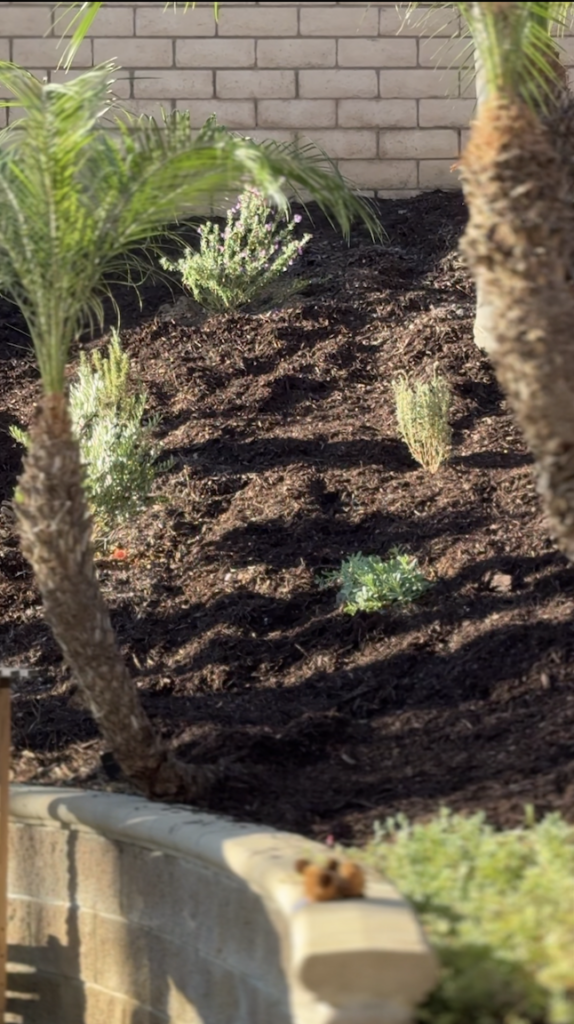
If you’re creating your own Mediterranean Southern California backyard, here are all of the plants we’re currently growing:
Little Ollie Dwarf Olive
One of the plants I knew I wanted from the beginning was Little Ollie dwarf olive.
Its soft gray-green foliage immediately gives the landscape that Mediterranean feeling, but Little Ollie stays much more manageable than a full-size olive tree.
It also gave us one of the main foliage colors that we repeated throughout the rest of the slope.
Upright Rosemary
We chose upright rosemary rather than a trailing variety because I wanted some height and structure among the lower-growing plants.
Rosemary feels right at home in a Mediterranean-inspired garden, loves sunshine, and fits beautifully into a Southern California landscape.
Plus, we can actually use it.
Lavender
It would have been hard for me to create this landscape without adding lavender.
Its gray-green foliage works beautifully with the olive and rosemary, while the purple flowers introduce some of the color I wanted throughout the slope.
As the plants grow, I think the lavender will also help give the landscape that softer, more relaxed look we were going for.
Bougainvillea
For brighter color and height, we added climbing bougainvillea in magenta. We placed them along the back wall of the slope and as they grow we will train them to climb the wall.
This is one of the plants that really gives me the Mediterranean feeling I wanted for the backyard. The vivid flowers look so pretty against all of the more muted green and silver foliage.
As it grows, it should give us a much bigger splash of color without having to fill the slope with flowering plants.
Texas Sage
We also incorporated Texas sage, with its silvery foliage and purple blooms.
It isn’t actually a Mediterranean plant, but visually it fits beautifully into this landscape. The foliage ties in with the olive and lavender, while the purple flowers repeat the colors we’re using elsewhere.
Rock Purslane
Rock purslane adds another completely different texture.
Its blue-gray succulent foliage fits right into the muted color palette, but then it produces these beautiful bright magenta-purple flowers.
I especially like plants like this because they add interest even when they aren’t blooming.
Ice Plant
We already had ice plant growing on a portion of the slope before three summers ago, and it spread so nicely!
We’re keeping it and letting it continue to fill in.
I also plan to add more ice plant in the spring, but I’m intentionally waiting until it’s flowering at the nurseries. I specifically want the hot-pink variety, and seeing the flowers in person will make it much easier to know I’m getting exactly the color I want.
Eventually, I’d love to see pockets of that hot pink spreading between some of the larger plants.
Adding Fruit Trees to Our Southern California Backyard
One of my favorite additions has been incorporating fruit trees into the landscaping.
I love the idea that the backyard can be beautiful while also giving us things we can actually eat.
Our Grafted Apple Tree
We planted a grafted apple tree on the slope in an area where some of the old hibiscus bushes had been.
Rather than filling that newly opened space with another purely ornamental plant, I loved the idea of putting a fruit tree there.
It gives us another layer of interest on the slope while beginning to make the backyard feel a little more productive, too.
Washington Navel Orange Tree
We also planted a Washington navel orange tree along the fence line where the largest bird of paradise had previously been.
This might be one of my favorite swaps in the backyard.
We went from a massive bird of paradise that was blocking part of our view to a citrus tree that feels much more intentional for the space—and will eventually give us oranges.
Citrus also feels completely at home with the Mediterranean-inspired direction of the rest of the backyard.
Working With the Landscaping We Already Had
Not everything needed to be new.
The mature palm trees throughout the slope stayed, and they give us height and privacy that would take years to recreate with new landscaping.
We also kept our burgundy cherry tree. Its dark foliage creates a really pretty contrast against all of the olive, silver and gray-green tones we’re introducing. Some years it also produces fruit!
And rather than replacing healthy ice plant that was already spreading, we incorporated it into the new design.
Keeping some established landscaping helps the new plants feel like they belong here rather than making the entire slope look like it was planted at once.
Landscaping a Sunny Southern California Slope
Landscaping a slope comes with its own challenges, especially when that slope gets a lot of sun.
Rather than trying to cover every square foot immediately, we intentionally left room between the new plants.
One of the easiest things to do with new landscaping is plant for what everything looks like today rather than what it will look like once the plants mature.
I’d rather have the slope look a little sparse in the beginning than spend more money filling every opening only to end up with an overcrowded landscape a few years from now.
We’re going to give everything time to grow before deciding where we actually need more.
It also gives us room to let the landscape evolve. If we find another plant we love or realize a certain area needs more groundcover, we can add it later.
Adding Mulch to Finish the Slope
Once all of the new plants were in, the landscaping still didn’t quite look finished.
The problem was all the exposed dirt between them.
Adding mulch was one of those relatively simple changes that made a surprisingly big visual difference. It created a consistent background across the hillside. Then the individual plants stood out so much more!
We added approximately two inches of brown shredded mulch across the slope, and it immediately made the new landscaping feel more finished.
How We Saved More Than $2,000 on Mulch
We were originally quoted about $2,300 to have the slope professionally mulched.
Instead, we decided we’d tackle it ourselves.
We spent $217 on the mulch and supplied the labor.
It’s not a perfect comparison because the professional quote included labor, but doing it ourselves meant a difference of more than $2,000!
And considering how simple the change was, it made one of the biggest immediate differences in the entire project.
What We’re Still Planning to Add
I’m intentionally not rushing to declare the landscaping finished.
For the slope, I already know I want to add more hot-pink ice plant in the spring. Beyond that, I want to see how everything grows before buying much more.
Some of the spaces that look empty today may disappear completely once the rosemary, lavender, bougainvillea and other plants mature.
I’d rather wait and make those decisions based on how the landscape actually develops.
But while we’re giving the landscaping time to grow, I have plenty of other plans for the backyard.
Starting My First Vegetable Garden
After our artificial turf is professionally cleaned, I’m finally going to do something I’ve wanted to try but have never done before! I’m going to start a vegetable garden!
I found these gorgeous, sleek raised garden beds that were surprisingly well priced. They look nice enough that I’m actually excited to have them out in the backyard. I am starting with two beds side by side in front of our BBQ island. I may add a third on the side.
I’m planning to start with bell peppers, orange peppers and jalapeños in one of the garden beds. I also want to add a separate pot for strawberries.
This will genuinely be my first time growing a vegetable garden, so I’m learning as I go. If you have any recommendations of what to plant in my other garden bed, let me know in the comments!
Next Summer: A DIY Backyard Pumpkin Patch
Next summer, I want to turn the rear corner of our slope into a DIY pumpkin patch!
The plan is to grow pumpkins from seed and let the vines spread through that portion of the hillside. Then in fall, we can hopefully walk into our own backyard and pick pumpkins we grew ourselves.
I love the idea of our daughter getting to watch them grow throughout the summer. And the more pumpkins for fall decor, the better!
With the apple and orange trees, strawberries, vegetable garden and pumpkins, this backyard makeover is about more than making the space prettier. It will be a backyard we actually use!
Our Southern California Mediterranean Landscaping Plant List
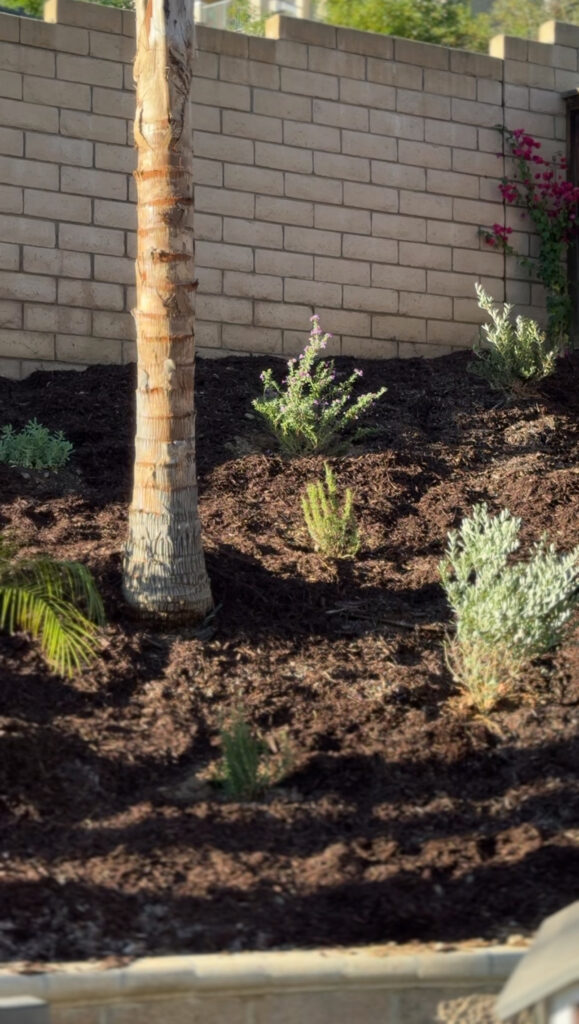
If you came here specifically looking for Mediterranean landscaping ideas for Southern California, here’s what we’re currently growing:
- Little Ollie dwarf olive — silvery-green foliage and structure
- Upright rosemary — evergreen structure and classic Mediterranean character
- Lavender — gray-green foliage and purple flowers
- Bougainvillea — bright, saturated color
- Texas sage — silvery foliage and purple blooms
- Rock purslane — blue-gray foliage and magenta-purple flowers
- Ice plant — spreading groundcover, with more hot-pink ice plant planned for spring
- Grafted apple tree — planted on the slope
- Washington navel orange tree — planted along the fence line
- Mature palms — existing plants incorporated into the new design
- Burgundy cherry tree — existing tree that adds deeper foliage color
What’s Next in Our Southern California Backyard Makeover
There’s still plenty left to do.
First up, we’re having our very neglected artificial turf professionally cleaned. I can’t wait to see the turf look brand new!
Then I’ll be planting my first vegetable garden, and adding a pot for strawberries.
Next summer, I’m hoping to turn that rear corner of the slope into our DIY pumpkin patch.
And someday, I’d still love to add that dream limestone trough fountain to complete the Mediterranean feel.
In between all of those projects, we’ll continue giving the new landscaping time to grow and figuring out what this backyard needs next.
What started as finally replacing landscaping we never really loved is turning into something much bigger: a backyard that feels more like us, gives us more reasons to spend time outside, and will eventually let us walk outside and pick everything from apples and oranges to peppers, strawberries and pumpkins.

Leave a Reply